Place
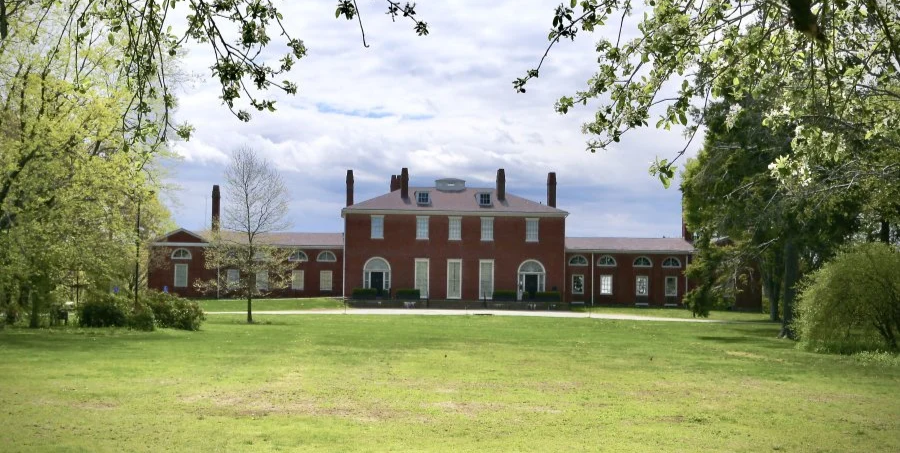
First, a bit of background courtesy of Gore Place Historic Estate:
Gore Place’s History
Located just nine miles west of Boston and less than half a mile from the Charles River, Gore Place has a long and fascinating history that spans centuries. Founded in 1935 to preserve and promote the historic country estate of Christopher and Rebecca Gore, Gore Place is a museum, working farm, and community resource that tells the story of early nineteenth-century American life. Explore this page to learn more about our unique history!
Who Lived Here?
Gore Place has been inhabited for at least four centuries. The Nonantum and Pequossette tribes fished, hunted, and raised crops in this area, and when they ceded this land to English colonists in 1630, the Reverend George Phillips—one of the founders of Watertown—chose this parcel to build his home. Since then the property has had a number of owners, most notably Christopher and Rebecca Gore, and author and abolitionist, Robert Roberts.
After Rebecca died in 1834 the house was sold to Boston Mayor Theodore Lyman, Jr., who added a floral garden and farmhouse to the property. Over the next century, the estate passed through a number of owners, including Nathaniel Singleton Copley Greene—grandson of John Singleton Copley, the famous painter—before it faced demolition in 1935. Gore Place Society was founded in May of 1935 to save the historic estate, and it continues to preserve the property today as a museum, working farm, and community resource.The 1806 Mansion and 1793 Carriage House
The Gores first purchased this land in 1786. The property included a house and a carriage house, and while the former burned to the ground a decade later, the Carriage House is still standing today just beside its original location.
The famous brick house, now referred to as the "mansion," was completed in 1806. The Gores turned the property into one of the most beautiful and well-known estates in New England, which was visited by notable guests such as James Monroe, John Quincy Adams, and Daniel Webster while Christopher served as Governor of Massachusetts and later as a U.S. Senator.
The Gores’ Carriage House was built in 1793. The building was an important part of the estate, as it housed carriages, horses, and stored a range of equipment including harnesses, saddles, bridles, and other tack. Hay and grain were also stored in the Carriage House, and the cellar was utilized to make compost for fertilizing fields.
So, why found an early music organization at Gore Place?
First, by all accounts, Rebecca & Christopher Gore were highly social and loved hosting gatherings in this home. We are grateful for the opportunity to partner with Gore Place to continue the tradition of bring elegant people, music, and food & drink together under their roof once more.
Second, much of the music we play from the 17th through 19th centuries was heard either primarily or exclusively in homes just as this one, sometimes at the specific request of the composer of the work and/or commissioner. The list of important works premiered in homes is seemingly endless. At the turn of the 19th century, the time of Gore Place’s construction, Viennese socialites were partying to the tunes of Franz Schubert’s art songs and chamber music at Shubertiades beginning in his own apartment and spreading in popularity to the homes of aristocrats in Vienna and beyond. Within the same two decades, three of five of Beethoven’s cello sonatas were premiered in private salon concerts (the first two were also, sort of, but more upscale: these took place at the Prussian Court of Berlin for King Friedrich Wilhelm II), as were the majority of his chamber music including the Op. 59 quartet, one of which we feature as our inaugural season opening concert. The century preceding the construction of Gore place also saw the use of private homes as the primary venue of ‘new’ music as the norm. Moving earlier still, while we know the overwhelming majority of Baroque music first graced its listeners ears in religious settings, many of these churches